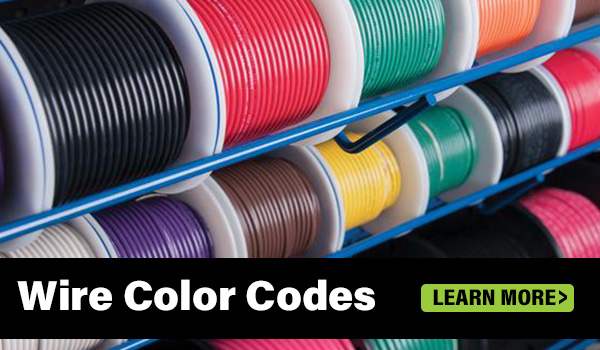
Wire color isn’t cosmetic — it’s a functional visual language that communicates exactly what each conductor is meant to do. Across automotive, trailer, solar, industrial, and equipment-based electrical systems, standardized wire colors improve safety, reduce installation errors, and make long-term maintenance far more efficient. When used consistently, these color conventions help technicians quickly identify circuit purpose, speed troubleshooting, and lower the risk of shock, equipment damage, or fire hazards.
Because there is no single universal DC wire color standard, conventions vary by industry and application. Understanding those differences is essential when installing, repairing, or modifying electrical systems. This guide outlines the most common DC wire color codes across major industries, typical wire sizes, and best practices for ensuring safe, reliable installation.
Quick Reference: Common DC Wire Colors
Across most DC systems:
- Red = Positive power
- Black (or white in some systems) = Ground/negative
- Blue = Brakes or control power
- Pink = Ignition-switched power
Always verify with a schematic before making connections.
Who Defines Wire Color Standards?
There is no single global authority for wire color codes. Instead, standards are influenced by several governing and industry bodies:
- National Electrical Code (NEC) – Defines required identification for grounded (neutral) and grounding conductors in U.S. installations and influences common hot-wire color practices.
- International Electrotechnical Commission (IEC) – IEC 60445/60446 establishes international conductor identification and terminal marking standards.
- Industry & Employer Conventions – Control panel builders, OEMs, vehicle manufacturers, and industrial facilities often adopt internal color standards to maintain consistency across systems.
Why Correct Wire Color Use Matters
Using correct wire color standards provides several important benefits:
- Improved Safety – Reduces risk of miswiring, shock, and fire hazards
- Faster Troubleshooting – Makes tracing circuits quicker and more accurate
- Professional Consistency – Creates predictable, maintainable installations
Whether wiring a control panel, repairing a vehicle harness, or installing a trailer connector, standardized color logic improves reliability.
DC Wire Colors Explained Across Industries
While no single universal DC color code exists, most industries follow consistent conventions. Below is a simplified breakdown of common DC color meanings and typical wire sizes.
Automotive Wire Color Codes & Sizing
Most passenger vehicles operate on 12V systems (24V in heavy trucks). The vehicle chassis typically serves as ground return.
Common Automotive Wire Colors
- Red – Constant battery power
- Black – Ground
- Yellow – Ignition-switched power
- Orange – Accessory power
- Brown – Parking/marker lights
- Blue – Trailer brake output or accessories
- Green – Turn signals (often right side)
- White – Ground (in some harnesses)
- Pink – Ignition power (common in GM vehicles)
Typical Automotive Wire Sizes
- Dashboard lights: 18–20 AWG
- Lighting circuits: 16–18 AWG
- Radios & accessories: 14–16 AWG
- Fuel pumps & cooling fans: 12–14 AWG
- High-draw accessories: 10–12 AWG
- Starter cable: 2 AWG – 4/0 AWG
- Main ground straps: 4 AWG – 1/0 AWG
Longer wire runs require larger gauge conductors to prevent voltage drop.
Trailer Wiring Color Codes
Trailer wiring is more standardized than automotive wiring.
4-Pin Flat (Small Utility Trailers)
- White – Ground
- Brown – Tail/marker lights
- Yellow – Left turn & brake
- Green – Right turn & brake
Typical size: 16–18 AWG (14 AWG recommended for ground)

7-Pin RV Blade (Most Common)
- White – Ground (10 AWG)
- Black – 12V auxiliary charge (10 AWG)
- Yellow – Left turn & brake (12 AWG)
- Red – Stop and Anti-Lock (12 AWG)
- Green – Right turn & brake (12 AWG)
- Brown – Tail (12 AWG)
- Blue – Auxiliary Circuit (12 AWG)
Brake and charge circuits use heavier gauge wire due to higher current demands.

Solar DC Wire Color Codes & Sizing
Solar systems operate at higher DC voltages and currents than automotive systems.
Common Solar Wire Colors
- Red – Positive
- Black – Negative
- Green or Bare – Equipment ground
- White – Grounded conductor (in some systems)
- Orange – High-voltage DC (in certain applications)
Typical Solar Wire Sizes
- Panel to combiner: 10–12 AWG
- Combiner to inverter: 8–2 AWG
- Battery interconnects: 2 AWG – 4/0 AWG
- Large off-grid systems: 4/0 AWG or larger
Battery cables must be sized for substantial current flow.
Industrial 24V DC Control Wire Color Codes & Sizes
Many factories standardize on 24V DC for machine control circuits.
Common U.S. Industrial DC Colors
- Blue – 24V DC control power
- White with blue stripe – DC common
- Red – AC control circuits
- Black – Line power
- Green or Green/Yellow – Ground
Typical Industrial Wire Sizes
- Control wiring: 16–18 AWG
- PLC I/O & sensors: 18–22 AWG
- Solenoids: 14–16 AWG
- DC distribution: 12–14 AWG
- Panel feeders: 10–12 AWG
Industrial environments prioritize clean labeling, ferrules, and consistent color logic.
Less Common but Important Wire Colors
- Pink – Ignition-switched power
- Purple – Reverse lights (trailers)
- Gray – Dashboard illumination
- Tan – Fuel pump (some vehicles)
- Light Blue – Brake switch
- Dark Blue – Trailer brake output
- Twisted pair (varied colors) – CAN bus and communication networks
Modern systems may also use shielded cable for sensors and twisted-pair wiring for data networks.
Selecting the Right Wire for Your application Building safe, dependable electrical systems starts with selecting the correct wire. Del City offers a full selection of primary wire, battery cable, hook-up wire, and specialty wiring solutions to support automotive, trailer, solar, and industrial applications.